Growing with AI: From Clinical Obesity to a $5M Health-Tech Revolution.
How a personal health transformation inspired a founder to turn a costly, outdated fitness experience into a scalable AI-powered solution, now serving thousands and redefining personal training.
Can you share the story behind your business? What inspired you to create it, and what problem are you solving?
The idea started after the personal health struggles that I had in my 20s. I was very overweight, I had no discipline around diet, or exercise, and never set foot in a gym before. Eventually, I was told that I was clinically obese and should lose weight sooner rather than later, so I ended up hiring a personal trainer here in London.
It was something that I’d never done before as I’d always found it intimidating but over the course of four months, I ended up losing about 30% of my body fat with this personal trainer. It was a sort of rapid transformation.
But having gone through this I realised just how expensive the process of personal training is, especially in London, and how analogue itis – you go into a gym, there's a guy standing there with a clipboard and pen just manually counting your reps and giving you verbal feedback on your form –there’s no data augmentation in the whole process.
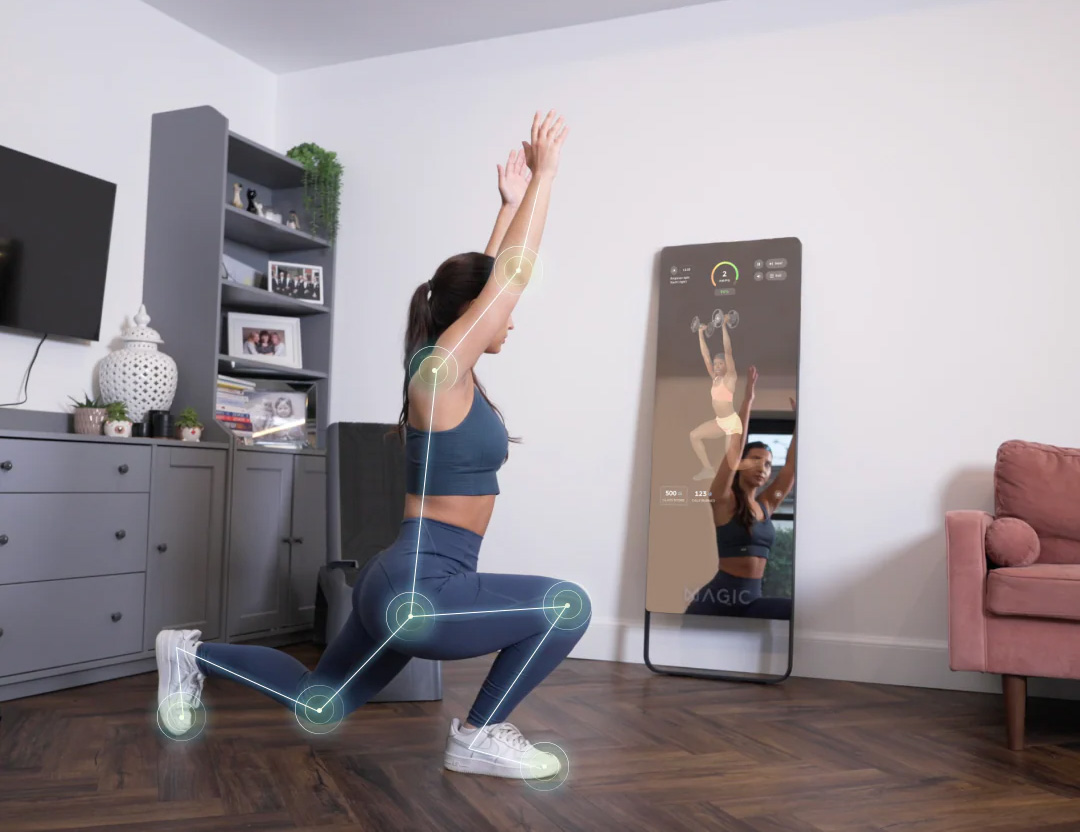
So, my co-founder and I started thinking, is there a way we could use AI to replicate the personal training experience that you would get with a human but use technology to deliver a one-to-one hyper-personalised training experience at a fraction of the price?
What were the biggest challenges you faced when launching your business?
We had little experience with technology; my co-founder was a bit more of a technical guy but not to the level needed to execute something like this, so it was a big challenge. We had to really do a lot of research, development and learning. It took us about 18 months of making a lot of mistakes along the way and then we eventually found the right developer who we could bring in-house to work alongside us and bring our vision to life.
How did you navigate building and scaling a team with the technical expertise needed for AI development?
We had a bit of experience, mainly through my co-founder, although not to the level required to execute our product. It took 18 months of research, development and a lot of learnings before we finally found the right developer who we could partner with to bring our product to life.
Over the last few years, what milestones have been most significant in your startup's growth?
Our launch last year was undoubtedly our biggest milestone, but we recently surpassed 3,000 customers, which is a significant achievement, especially considering we've only been trading for just over a year.
Are there any other successes you would like to share?
We've managed to build training models for our AI which has been a big success; we now have more than 400 different exercise training models, making ours one of the largest of its kind, I think, which is really quite exciting!
We’re hoping to triple this over the next year and start building more models with a bigger team and, because we’ve had that commercial traction, we’ve managed to close a recent funding round of $5m to make this happen which I’d consider a great success as well.
What are your ambitions for the future of your business?
The big one, I think, is that we’re keen to go deeper into health rather than just fitness. So, potentially we can implement a camera feature that allows the AI to actually scan the user's body and give a reading of their health and biometrics, and then recommend tailored improvements based upon this. At that point we’d essentially be creating not just a personal trainer but a health coach, so that’ll be exciting!
Another big one is international expansion. We already export to Europe and the US from the UK, but I think what we want to do is actually set up operations, most likely in the US, within the next 12 months or so.
What advice would you give to other founders looking to build and scale an AI business?
Good question. I guess, because AI is changing so quickly, my advice for budding entrepreneurs is to try and pick an area where there’s a problem that they've personally experienced because products that address this are often timeless and you’ll have more drive and dedication to bring it to life.
With us, I was really scratching my own itch and trying to address my personal problem – AI just happened to offer a great opportunity to bring it to life.
I think a lot of people just focus on the technology itself and try to find a use for it – essentially a solution in search of a problem – when it should be the other way around.
Ready to discover how we are shaping the future? Download our 2025 Impact Report